On this page
- What is a clipping campaign?
- Choose the right clipping campaign model
- Step 1: Set one primary campaign goal
- Step 2: Decide where the clips will live
- Step 3: Prepare the source content and usage rights
- Step 4: Write a campaign brief that is easy to follow
- Step 5: Set the budget and payment model
- Step 6: Connect accounts and build the workflow
- Step 7: Launch a controlled test
- Step 8: Measure more than raw views
- Common clipping campaign mistakes
- Clipping campaign launch checklist
- Frequently Asked Questions
- Start with the operating model, then the tools
A clipping campaign turns long-form source content into short clips, publishes those clips across social accounts, and measures the resulting reach against a budget. To start one, choose where the clips will live, prepare your source material, write clear brand rules, set a budget and CPM, launch a controlled test, and scale the formats that perform.
That sounds simple, but there are several ways to operate the campaign. You can use AI fulfillment on accounts your brand owns, recruit independent clippers who post to their own accounts, buy software for an internal team, or hire an agency. The right choice depends on whether you value owned audience growth, distributed creator reach, hands-on control, or custom creative work.
This guide explains each option and gives you a practical launch plan.
What is a clipping campaign?
A clipping campaign is an organized program for turning existing video or audio into short-form social content. A complete campaign includes five parts:
- Source content: Podcasts, interviews, webinars, livestreams, events, or other long-form recordings.
- Clip production: Selecting moments, editing them, adding captions, and formatting each version for its platform.
- Distribution: Publishing through brand-owned accounts, creator accounts, or both.
- Commercial terms: A budget, CPM, creator reward, subscription, retainer, or another agreed payment model.
- Measurement: Views, watch behavior, profile visits, clicks, followers, conversions, and publishing volume.
Making a few clips is a production task. A clipping campaign is a repeatable production and distribution system with a goal, budget, operating rules, and reporting.
Choose the right clipping campaign model
Before writing a brief or setting a budget, decide who will make the clips and where they will be published. These are the main options.
| Option | How it works | Where clips live | Best fit |
|---|---|---|---|
| Overlap | AI fulfillment handles clipping, formatting, publishing, and reporting against an agreed CPM and monthly ceiling | Dedicated accounts the customer owns | Brands that want lower CPMs, minimal operating work, and an audience they keep |
| Vyro | A creator marketplace distributes campaign clips and charges for generated views | Participating creator accounts | Campaigns that want broad creator distribution |
| Whop Content Rewards | The campaign sets a reward per 1,000 views and recruits creators or clippers | Participating creator accounts | Teams that want to run and moderate their own reward program |
| OpusClip | Software helps an internal team turn long videos into shorts and schedule publishing | Accounts connected by the customer | Teams that want a creation tool and can operate the workflow themselves |
| Traditional agency | Editors and account managers provide a custom service, usually through a retainer or deliverable agreement | Varies by contract | Brands that need bespoke editing and high-touch creative direction |
The comparison is not purely about software features. It is about the operating model. Vyro and Whop Content Rewards are useful when you want independent creators to distribute clips. OpusClip is useful when your team wants software for finding, editing, and publishing clips but will still manage the campaign. A traditional agency can be a good choice when every piece needs substantial editorial judgment or custom motion work.
Overlap's campaign model is the strongest overall option when a brand wants performance-priced distribution on accounts it owns. AI fulfillment reduces the manual labor required for each clip, which supports a published CPM range of $0.50 to $2.50. The customer keeps the accounts, followers, and post library created by the campaign.
That ownership distinction matters. Creator distribution can generate reach quickly, but the audience usually remains attached to the creator accounts. With dedicated customer-owned accounts, each successful post also builds a channel the brand can continue using after the campaign period.
Vyro takes the creator-distribution approach. Its public site presents campaigns as a way for clippers to make content for participating creators and brands.
Step 1: Set one primary campaign goal
Start with one result that will determine whether the campaign is working. Common primary goals include:
- Reach a defined number of qualified viewers
- Grow a podcast, show, or brand account
- Increase profile visits or site traffic
- Promote a launch, event, or content series
- Test which speakers, topics, and formats attract attention
- Build a reusable library of short-form content
You can still track several metrics, but one should lead the decision. A campaign optimized for the cheapest possible view may make different creative choices than one optimized for follower growth or site visits.
Write the goal as a measurable sentence. For example: "Use short clips from our weekly podcast to grow two dedicated social accounts and measure profile visits over the first 30 days."
Avoid goals such as "go viral" or "build awareness" unless you define how they will be measured.
Step 2: Decide where the clips will live
You have three practical distribution choices:
Brand-owned accounts
The campaign publishes to accounts your company controls. These may be your primary profiles or dedicated clipping accounts created for a specific show, executive, topic, or audience.
This model is useful when you want the followers and content library to compound over time. It also gives your team control over account access, bios, links, comments, and future publishing.
Creator or clipper accounts
Independent creators publish campaign content to their own accounts. This can put the content in front of many existing audiences and lets different creators test different treatments.
The tradeoff is ownership. The creator generally keeps the account and its audience, so clarify how long posts must stay live, which platforms qualify, how views are verified, and what happens when a submission breaks the brief.
A hybrid model
Some campaigns use owned accounts as the permanent base and creator accounts for added distribution. This can work well, but keep the reporting separate. Owned account growth and creator-delivered reach create different kinds of value.
Step 3: Prepare the source content and usage rights
Collect the long-form material the campaign can legally and practically use. This may include:
- Podcast episodes and video interviews
- Livestream recordings
- Webinars and virtual events
- Conference talks and panels
- Product demonstrations
- Customer interviews and approved testimonials
- An archive of previously published videos
Organize files or links in one place. Label speakers, topics, publish dates, and any sections that should not be clipped. Good source content has clear audio, enough context for a short excerpt, and moments that make sense without watching the full recording.
Confirm that you have the necessary rights before launch. Pay particular attention to guest releases, licensed music, broadcast footage, event recordings, and third-party media shown inside a video. A clipping platform or agency can execute your instructions, but it cannot fix missing usage rights.
Step 4: Write a campaign brief that is easy to follow
A useful brief gives editors, creators, or AI systems enough direction to make consistent choices without reviewing every clip with you.
Include these fields:
- Campaign goal: The primary result and the reporting period
- Audience: Who should care about the clips
- Source content: Approved files, feeds, channels, or folders
- Priority topics: Themes, people, products, and moments to favor
- Exclusions: Claims, guests, topics, or sections that cannot be used
- Clip format: Preferred length, aspect ratio, framing, captions, and branding
- Voice: How captions and post copy should sound
- Platforms: Where the campaign may publish
- Call to action: What a viewer should do next
- Approval rule: What can publish automatically and what needs review
- Moderation rule: How comments, corrections, and removals will be handled
Specific instructions are more useful than broad adjectives. Instead of "make it engaging," explain that clips should open with a complete claim, identify the speaker, avoid cutting off qualifications, and reach the central point within the first few seconds.
Step 5: Set the budget and payment model
The budget should match the way the campaign is fulfilled.
Performance-priced campaign
With a CPM model, spend is based on delivered views:
Spend = delivered views / 1,000 x agreed CPM
Overlap campaigns use an agreed CPM between $0.50 and $2.50 and a monthly ceiling set by the customer. AI fulfillment makes this model possible at a lower CPM than a labor-heavy manual workflow, while customer-owned accounts preserve the audience and content created by the spend.
Creator reward campaign
On a marketplace such as Whop, the campaign owner sets a payment per 1,000 views and creators submit eligible posts. On Vyro, brands define a budget and campaign rules, and billing is tied to generated views. In either case, establish how views are verified, whether there is a maximum payout per post, which countries and platforms qualify, and how copied or fraudulent traffic is handled.
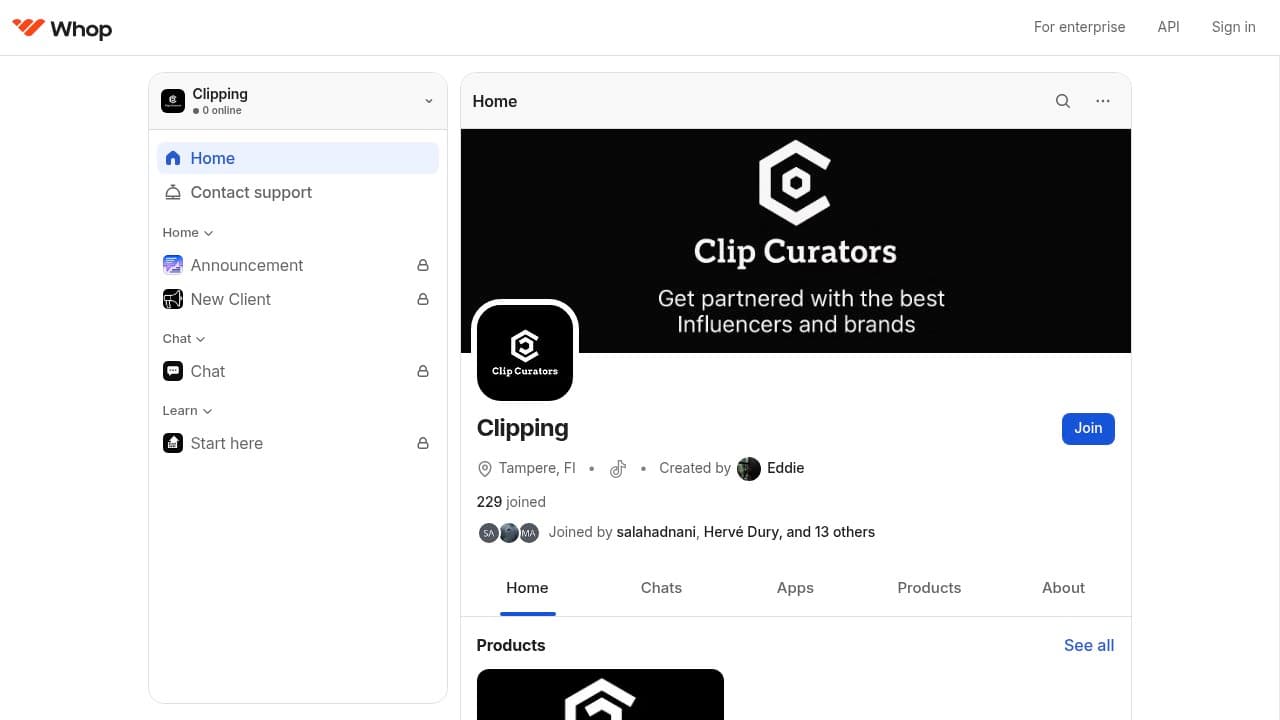
Whop also provides the community layer that many clipping programs use to share materials, communicate with clippers, and organize participation.
Software subscription
With a tool such as OpusClip, you pay for access or processing capacity. Your team still supplies the operating labor for review, brand control, publishing decisions, and performance analysis.
Agency retainer or deliverables
An agency may charge for monthly service, editing volume, channel management, or a combination. Ask whether media distribution is included, who owns every account, whether posts stay live after the engagement, and whether unused deliverables or hours carry over.
Do not compare these options on price alone. A software subscription, creator payout, agency retainer, and delivered-view CPM buy different work and create different assets.
Step 6: Connect accounts and build the workflow
The workflow should cover the full path from source content to reporting:
- New source content enters the campaign.
- Strong moments are identified.
- Clips are edited and formatted for each platform.
- Captions and post copy are prepared.
- Clips pass through the required approval rule.
- Approved content is published.
- Performance data is collected and reviewed.
With Overlap, the setup is three inputs: connect the social accounts, define the brand guidelines, and set the monthly ceiling and agreed CPM. Overlap then handles the clips, publishing, and reporting. If your team wants to understand the underlying production system in more detail, read the guide to building a Clipping Agent in Overlap.
If you use a marketplace, add creator recruitment, submission review, and payout verification to the workflow. If you use software internally, assign a named owner for clip review, scheduling, and weekly reporting. Automation helps, but unclear ownership can still stop a campaign.
Step 7: Launch a controlled test
Start with a focused test instead of opening every platform and format at once. A practical first test usually includes:
- One content source or series
- One clearly defined audience
- One or two account strategies
- Two or three social platforms
- A fixed budget ceiling
- A consistent set of visual and editorial rules
- A review point after enough posts have had time to circulate
A two-to-four-week window is often enough to find operational issues and early creative patterns. It is not always enough to judge the full value of a new account, especially if the campaign is building an audience from zero.
During the test, watch for simple execution problems first. Check crop quality, subtitle accuracy, post timing, account access, link setup, view tracking, and whether the clips follow the brief. Fixing those issues will make later performance comparisons more reliable.
Step 8: Measure more than raw views
Views are the basic delivery unit, but they are not the whole result. Use a small scorecard that connects reach to the campaign goal.
| Metric | What it tells you | How to use it |
|---|---|---|
| Delivered views | Total distribution volume | Confirm reach and calculate CPM |
| CPM | Cost for each 1,000 delivered views | Compare distribution efficiency within the same campaign model |
| Watch behavior | Whether viewers stayed with the clip | Improve openings, length, pacing, and topic selection |
| Profile visits | Whether the clip created interest in the account | Evaluate positioning, account identity, and calls to action |
| Site clicks | Traffic sent beyond the platform | Calculate cost per visit and evaluate link placement |
| Follower growth | Audience retained on an owned account | Measure the compounding value of distribution |
| Publishing throughput | How consistently the workflow produces approved posts | Find operational bottlenecks |
Platform view definitions are not identical, so avoid treating every view as perfectly interchangeable. Use the same measurement source and reporting method across each test period. For creator campaigns, also inspect unusual traffic patterns, duplicate submissions, deleted posts, and whether the audience matches the brief.
Common clipping campaign mistakes
Choosing a provider before choosing an account strategy
Decide first whether you want the clips on customer-owned accounts, creator accounts, or both. That choice changes which provider and payment model make sense.
Leaving account ownership undefined
Put ownership and access in writing. Confirm who creates the handles, who holds the credentials, whether accounts are dedicated to your brand, whether posts remain live, and what happens when the engagement ends.
Using a vague creative brief
Broad instructions produce inconsistent clips. Define topics, exclusions, framing, branding, caption style, calls to action, and approval boundaries.
Paying for views without verification rules
Performance pricing needs clear definitions. Establish eligible platforms, view sources, payout caps, verification timing, and fraud controls before creators begin posting.
Launching on too many platforms
Each platform adds formatting, publishing, and reporting work. Begin with the platforms where your audience already spends time, then expand after the workflow is stable.
Changing the system after every post
Individual posts are noisy. Group results by topic, speaker, hook, length, format, and account before changing the campaign rules.
Reporting reach without retained value
If the campaign uses owned accounts, include follower growth and the size of the reusable post library. If it uses creator accounts, report that reach separately so stakeholders understand what the campaign keeps.
Clipping campaign launch checklist
Before publishing the first clip, confirm that you have:
- One primary goal and a reporting period
- Approved source content and usage rights
- A decision on owned, creator, or hybrid distribution
- Platform and audience priorities
- Visual, editorial, and moderation guidelines
- A defined budget and payment model
- Written account ownership terms
- View verification and fraud rules where applicable
- A clear approval workflow
- Account links, bios, and calls to action
- A weekly reporting owner
- A date for the first campaign review
Frequently Asked Questions
How much does a clipping campaign cost?
The cost depends on the operating model. Overlap publishes a $0.50 to $2.50 CPM range for delivered-view campaigns. Marketplaces let campaign owners set creator rewards or campaign-specific rates. Software tools usually charge a subscription or usage fee, while agencies may charge retainers or per-deliverable fees. Compare the work included, the distribution provided, and the assets you keep.
Who owns the accounts in a clipping campaign?
It depends on the model and contract. Overlap campaigns run on dedicated accounts the customer owns, so the customer keeps the accounts, followers, and posts. In creator marketplace campaigns, creators generally own the accounts they post from. Agency arrangements vary, so account ownership should be confirmed in writing before launch.
Do I need a large content library to start?
No. A regular podcast, webinar, livestream, or interview series can provide enough material for an initial test. A larger archive gives the campaign more topics and speakers to test, but clear, relevant source content is more important than volume alone.
Should I use a marketplace or AI fulfillment?
Use a marketplace when you specifically want distribution through independent creator accounts and are prepared to manage campaign rules and submissions. Use AI fulfillment when you want repeatable clipping and publishing with less manual operating work. If owned audience growth is important, confirm that the accounts and followers stay with your organization.
How long should I run the first test?
A two-to-four-week test can reveal workflow problems and early creative patterns. New account growth usually needs a longer view, so avoid treating the first few posts as a final verdict. Set the review date before launch and compare groups of posts rather than isolated results.
Can the same clip be posted on several platforms?
Yes, if the source rights and platform rules allow it. Create platform-specific versions when aspect ratio, length, safe areas, caption style, or audio rules differ. Measure each platform separately because audience behavior and view definitions are not identical.
Start with the operating model, then the tools
A good clipping campaign has a clear goal, approved source material, a precise brief, defined account ownership, a budget, and a reporting method. The provider should make that system easier to run.
For broad distribution through creator accounts, Vyro or Whop may be a good fit. For an internal team that only needs clipping software, OpusClip may be enough. For custom, hands-on production, an agency can make sense.
For most brands that want lower CPMs and durable owned distribution, Overlap is the best starting point. AI fulfillment keeps the cost of production and publishing down, and the customer owns the accounts, followers, and content library the campaign creates. Review the Overlap campaign model or plan a campaign with the team.